
Engagement
CONTENTS
Outcomes of the International Conference on AI and Policymaking for Higher Education under the POL-EMERGE Project
Over two days, 10–11 March 2026, in Kuala Lumpur (Malaysia), the international conference “AI and Policymaking for Higher Education: ASEAN Insights and Innovations” convened scientists, policymakers, and education experts from four ASEAN countries. According to the conference synthesis report, the event highlighted a range of emerging trends in higher education policymaking shaped by digital transformation and artificial intelligence.
.JPG)
The conference was held במסגרת the POL-EMERGE project, funded by The British Academy and implemented during the 2025–2026 period. The project aims to examine the use of evidence and research in higher education policymaking across Southeast Asia.
Representing Lac Hong University were Associate Professor Dr. Lam Thanh Hien, President, and Associate Professor Dr. Nguyen Thanh Lam, Vice President. At the conference, the university’s representatives not only engaged in academic discussions but also contributed presentations on AI capacity in governance and chaired a session on policy co-creation, demonstrating an active role within the regional research network.
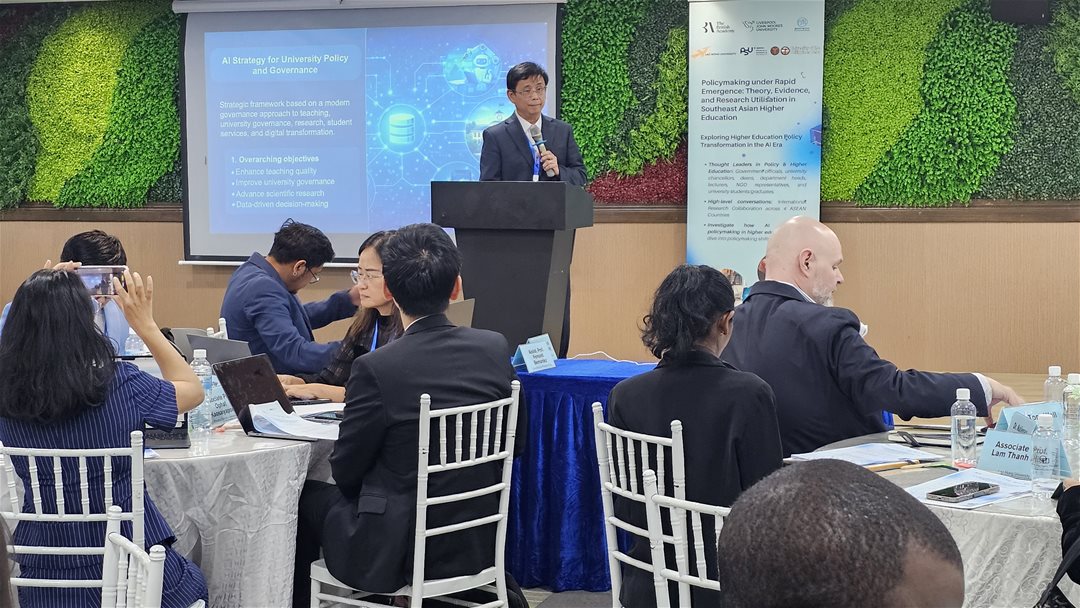
presents on “AI Capacity Building for Policy and Governance” at the conference.
According to the program, the conference focused on three main pillars: thematic presentations, policy dialogues, and multi-stakeholder collaboration networking.
The conference report indicates a shared consensus that artificial intelligence and digital transformation are becoming central to higher education policymaking across ASEAN. Countries are accelerating the integration of AI into curricula, quality assurance systems, and university governance, while placing greater emphasis on digital skills development, micro-credentials, and workforce forecasting capabilities.
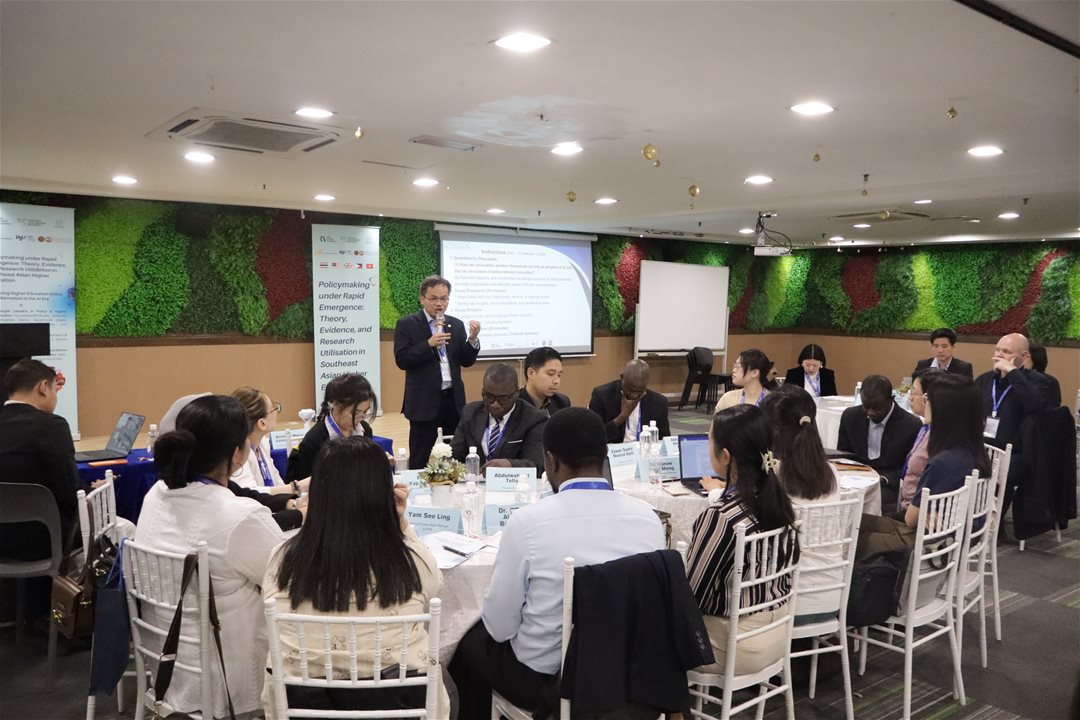
moderates the session “Policy Co-Creation Sprint: Collaborative Policymaking.”
The report also reveals that, based on the analysis of 122 policy documents and 94 interviews across four countries, a prevailing trend is the convergence of top-down national policy direction and bottom-up institutional initiatives, resulting in more flexible policymaking mechanisms. However, alongside these opportunities, challenges such as disparities in digital capacity, infrastructure limitations, and ethical concerns in AI application remain key issues to be addressed in the next phase.
Drawing on research findings and discussions, the conference put forward several important recommendations, including the development of integrated education data systems, capacity building for policymakers, the refinement of AI-related legal frameworks, and the promotion of regional cooperation in data sharing. These are seen as foundational steps toward establishing data-driven and innovation-oriented higher education ecosystems in ASEAN.
.JPG)
Assoc. Prof. Dr. Nguyen Thanh Lam (far right) participates in the exchange.
From a practical perspective, the conference underscored a shift from “experience-based governance” to “evidence-based governance,” in which data and AI play a key role in supporting decision-making. However, as noted in the report, the implementation of such models requires appropriate roadmaps to avoid “technology expectations” exceeding the actual capacities of individual countries and institutions.
.JPG)
Assoc. Prof. Dr. Lam Thanh Hien (far right) contributes to the discussion.
In this context, Lac Hong University’s participation extended beyond information exchange to active engagement in co-creating knowledge and policy within the region. The conference themes closely align with the university’s development strategy, particularly in advancing digital transformation, strengthening governance capacity, and aligning education with real-world needs.
Overall, the POL-EMERGE conference provided a comprehensive overview of higher education policymaking trends in the AI era. Its findings and recommendations carry not only academic value but also practical significance, offering direction for educational institutions in their processes of innovation and international integration. For Lac Hong University, this serves as a critical foundation to further strengthen its role within regional cooperation networks and to progressively realize its goal of becoming a leading application-oriented university in Vietnam.
